That Feeling When

A social-emotional building card game

As a part of my Senior Capstone Project at Stanford, my three teammates and I spent 20 weeks researching and designing a social-emotional card game aimed for use by 5th-8th grade students.

Year: 2021
Role: UX Researcher, UI Designer
Affiliation: Stanford University's ME216B/C Senior Capstone Class
Project Overview

Problem Statement to Opportunity

The pandemic both revealed and exacerbated the urgency of social-emotional learning (SEL) in schools, and with the $123 billion infusion to K-12 education by the American Rescue Plan (ARP) Act of 2021, this is an unprecedented opportunity to allocate innovative practices in SEL.

Millions of children nationwide were suddenly faced with the mandatory stay-at-home orders and long isolation periods, all while having to juggle school and inadequate channels for emotional processing. For us, this provided an opportunity to sit down with students, parents, teachers, and other school administrators to have candid conversations about the reality of social-emotional well-being of students during the pandemic. Due to proximity, we decided to focus in on the Los Angeles Unified School District (LAUSD) community.
Users & Demographics

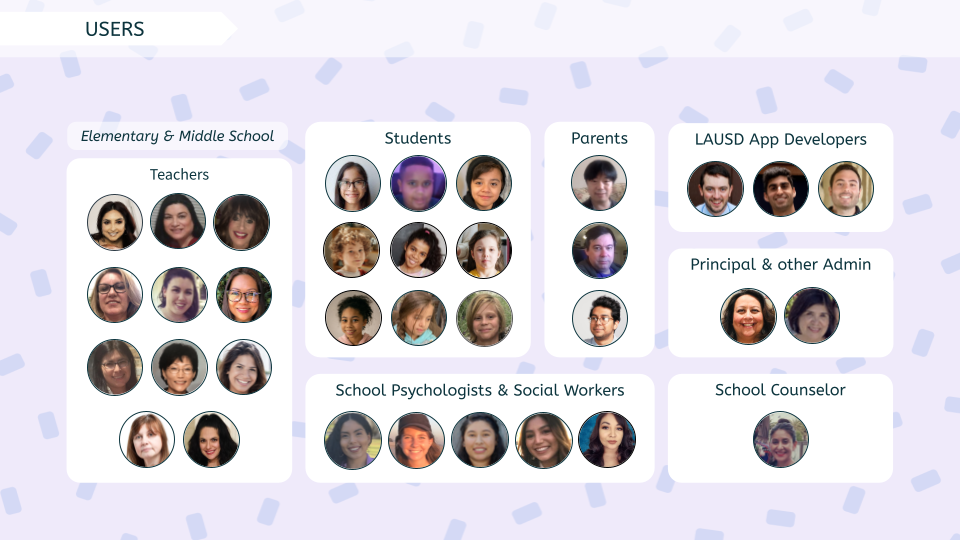
We identified our first users as educators. During the pandemic, they received new mandatory LAUSD standards for teaching daily social-emotional lessons, however lacking resources and guidance for doing so. Overall, their goal was to support students socially and emotionally by teaching them how to cope with negative emotions. Some other points of consideration we had to account for was LAUSD's goal to transition to hybrid classes which would have involved time-consuming lesson planning for both the virtual and in-person settings.

Our second users are the 5rd-8th grade students. Their goals were to have fun, and for many of them this meant playing social games. Popular social games incorporate elements of humor, expression, random chance, and reward systems. From our interviews, students felt that school had not been providing fun learning experiences pre and post pandemic. Additionally, the pandemic has them feeling in inarticulate ways and are left to ruminating over emotions they do not have the words for.

In general, our stakeholders included LAUSD administrators, psychologists, parents, and students.

Insights & Design Principles

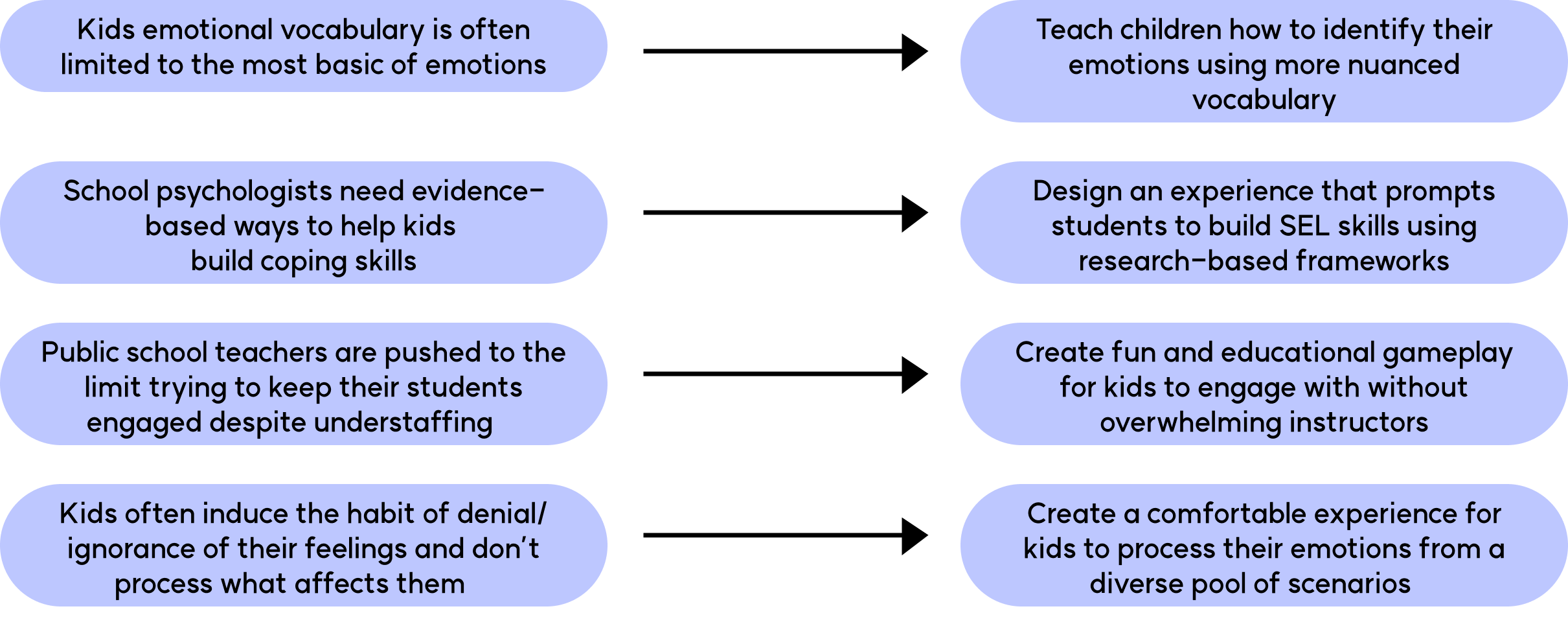
To gather insights from our users, we ran multiple Zoom interviews with students, teachers, psychologists, and principals. From this research and multiple reinterviewing sessions with our participants, we began to compile all of the various insights into more cohesive ones. We found these to be cohesive based on whether it was an insight highlighted by all parties or whether they revealed something new.

Approach & Product Ideation

Once we gathered insights we sifted and categorized needs into groups trying to find the best way to tie together the needs and the interests of all stakeholders including the students who would have the most direct impact.

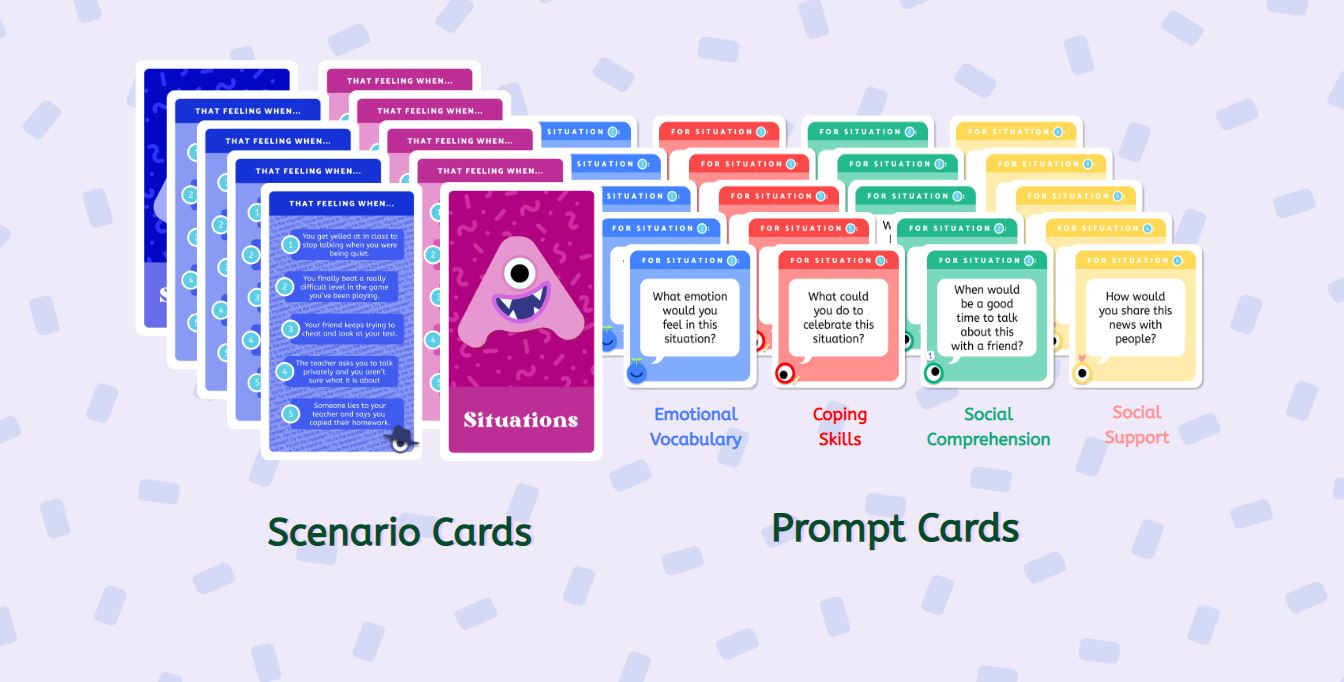
Our solution was to develop an educational card game aimed at students transitioning to in-person learning. Its meant for 5th-7th grade students to play in small groups of 4-8 players. In our game, students have to answer SEL prompts based on a situation they are placed in--but there is a catch: one student is given a different situation than the rest and the others have to figure out who it is.

In answering prompts, students practice identifying emotions, learning facial expressions and body language associated with certain emotions, and positive coping strategies and response skills. We created scenario cards which displayed real life scenarios that multiple students had gone through at some point in their life or through the pandemic. They would then respond to them using prompt cards in different categories such as emotional vocabulary, coping skills, social comprehension and social support.

Complexities & Constraints

One of the main constraints we had during this entire process was learning to adapt to the fact that we were navigating a current and ongoing experience. We had to adapt to the changing conditions of the pandemic, the unexpected ways in which feelings, availabilities, and our approach to our solution would mold itself around the changing ways of our present lives. It was also difficult for ourselves being in the pandemic itself, having to communicate with team members across our own lives amidst the pandemic. Nonetheless, this project was a a very insightful and enlightening way to end our academic careers as product design majors.

Lessons Learned & Next Steps

We actually started out wanting to develop a digital extension program that could be implemented through Schoology's platform. However, with further research into the process of being approved by LAUSD usage, we realized that we would not be able to have it approved in time for our timeline. Furthermore, we spent a lot of time changing the content and mechanics of the product itself to help students best develop social emotional skills, we went from extension to digital game to card game. This was my most intensive product commitment and I learned a lot about contending with user insights and project goals. There were a lot of moments of growth for me especially as I took on UX research, UI design, mechanics, and marketing development.

In terms of next steps, a few members of my team and I are looking to continue working on this throughout the next few years hopefully getting our product into classrooms, homes, and other educational spaces across the country.